
POLICIES
1. Focus and Scope
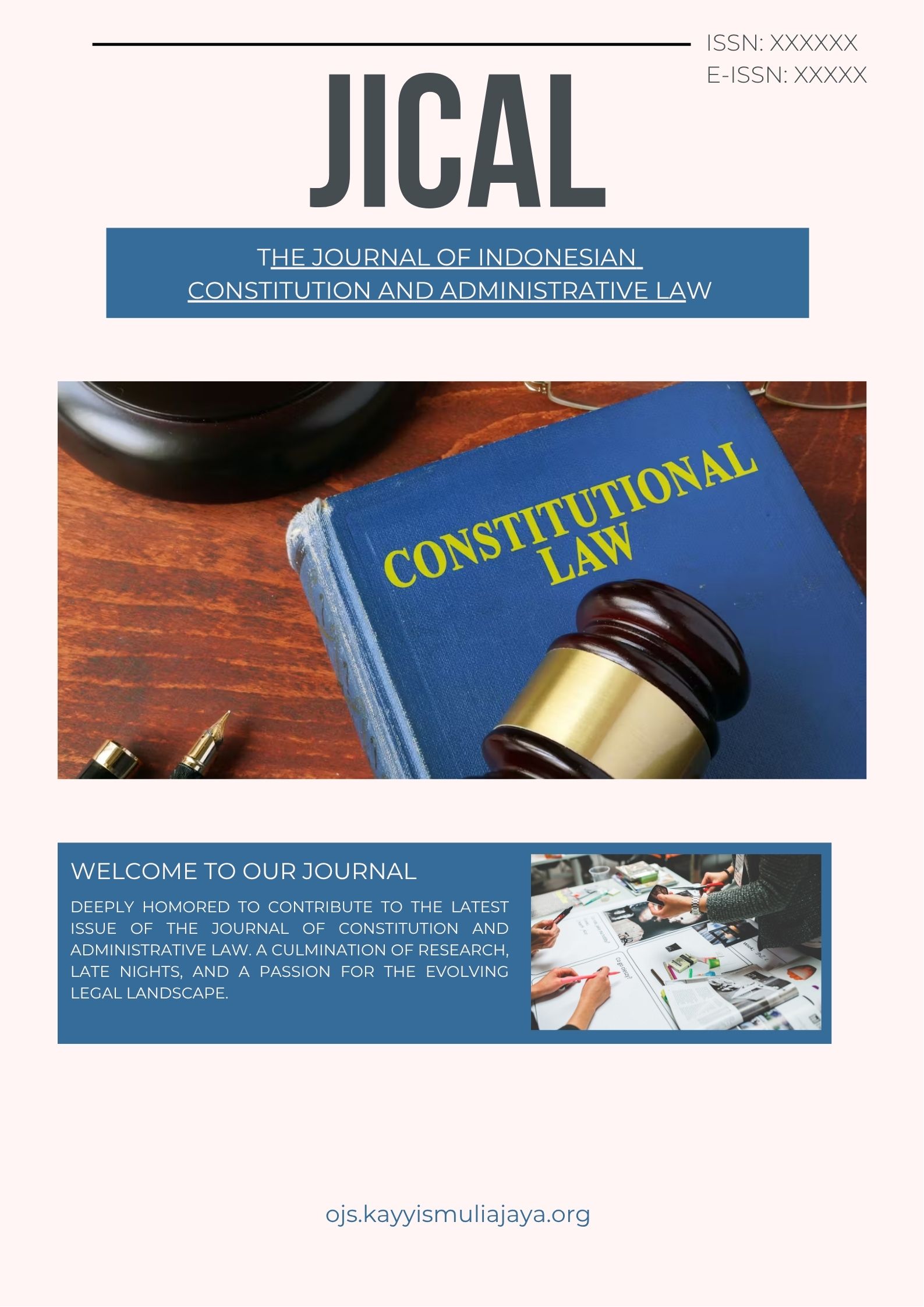
Journal of Indonesian Constitutional and Administrative Law (JICAL) is a peer-reviewed academic journal dedicated to the development of legal scholarship in the fields of constitutional law, administrative law, governance, public policy, and related legal studies.
The journal welcomes original research articles, conceptual papers, case analyses, comparative legal studies, and systematic literature reviews concerning:
- Constitutional Law;
- Administrative Law;
- Administrative Justice and Administrative Courts;
- Legislative Drafting and Regulatory Reform;
- Government Administration;
- Public Governance and Good Governance;
- State Institutions and Constitutionalism;
- Human Rights and Constitutional Rights;
- Decentralization and Regional Governance;
- Digital Governance and Electronic Government;
- Public Policy and Regulatory Impact;
- Legal Theory and State Law;
- Comparative Constitutional and Administrative Law.
2. Section Policies
Research Articles
Original manuscripts reporting the results of legal research, doctrinal studies, socio-legal research, empirical legal studies, or normative legal analysis.
- Open Submission
- Peer Reviewed
- Indexed
Review Articles
Critical reviews, systematic literature reviews (SLR), and state-of-the-art analyses of contemporary legal issues.
- Open Submission
- Peer Reviewed
- Indexed
Case Notes and Legal Commentary
Scholarly analyses of judicial decisions, constitutional court judgments, administrative court decisions, and emerging legal developments.
- Open Submission
- Peer Reviewed
- Indexed
3. Open Access Policy
JICAL provides immediate open access to all published content based on the principle that making research freely available to the public supports the global exchange of knowledge.
All published articles are freely accessible without subscription fees and may be read, downloaded, copied, distributed, printed, searched, or linked by users for lawful academic purposes.
4. Copyright and Licensing Policy
Authors retain copyright of their published work while granting JICAL the right of first publication.
Published articles are licensed under the Creative Commons Attribution 4.0 International License (CC BY 4.0), unless otherwise specified.
Under this license:
- Authors retain ownership of copyright;
- Users may share and adapt the material;
- Proper attribution must always be provided;
- The original publication in JICAL must be acknowledged.
5. Archiving Policy
To ensure long-term preservation and accessibility of scholarly content, JICAL implements digital archiving mechanisms.
The journal supports:
- PKP Preservation Network (PKP PN);
- LOCKSS/CLOCKSS (if activated);
- Institutional Repository Archiving;
- Author Self-Archiving.
Authors are encouraged to deposit published articles in institutional repositories, personal websites, or academic networking platforms while citing the official publication version.
6. Peer Review Process
All submitted manuscripts undergo a double-blind peer review process.
Editorial Screening
The Editorial Board evaluates submissions for:
- conformity with the journal scope;
- originality;
- scientific quality;
- compliance with author guidelines.
Peer Review
Eligible manuscripts are reviewed by at least two independent reviewers.
Reviewers evaluate:
- originality;
- legal significance;
- methodological rigor;
- clarity of argumentation;
- relevance of references;
- contribution to legal scholarship.
Editorial Decision
Possible decisions include:
- Accept;
- Minor Revision;
- Major Revision;
- Reject.
The final publication decision rests with the Editor-in-Chief.
7. Publication Ethics and Malpractice Statement
JICAL adheres to the principles of the Committee on Publication Ethics (COPE) and expects editors, reviewers, and authors to maintain the highest ethical standards.
Authors must:
- submit original work;
- avoid plagiarism;
- properly acknowledge sources;
- disclose conflicts of interest;
- avoid duplicate submissions.
Reviewers must:
- maintain confidentiality;
- provide objective assessments;
- disclose conflicts of interest;
- identify relevant uncited work.
Editors must:
- act fairly and impartially;
- maintain confidentiality;
- avoid conflicts of interest;
- make publication decisions solely on academic merit.
8. Plagiarism Policy
All manuscripts are screened using plagiarism-detection software before peer review.
The journal applies the following standards:
- Similarity Index above 25%: rejected or returned for substantial revision;
- Similarity Index 15–25%: revision required;
- Similarity Index below 15%: may proceed to review, subject to editorial assessment.
Plagiarism, self-plagiarism, data fabrication, and citation manipulation constitute publication misconduct.
9. Artificial Intelligence (AI) Policy
Authors may use AI-assisted tools solely to improve grammar, language, and readability.
AI tools:
- cannot be listed as authors;
- cannot assume responsibility for the content;
- must be disclosed in the manuscript if used substantially.
Authors remain fully responsible for the accuracy, integrity, and originality of their work.
10. Research Integrity and Misconduct
The journal will investigate allegations concerning:
- plagiarism;
- duplicate publication;
- data fabrication;
- data falsification;
- citation manipulation;
- authorship disputes;
- peer-review manipulation.
Investigations will follow COPE guidelines and may result in:
- correction;
- expression of concern;
- retraction;
- publication ban.
11. Retraction, Correction, and Withdrawal Policy
Retraction
Published articles may be retracted when serious ethical violations or fundamental errors are identified.
Correction
Minor errors that do not affect the validity of the research may be corrected through an erratum or corrigendum.
Withdrawal
Manuscripts may be withdrawn before publication upon approval of the Editor.
12. Conflict of Interest Policy
Authors, reviewers, and editors must disclose any financial, institutional, professional, or personal relationships that could influence their judgment.
Failure to disclose relevant conflicts may result in rejection or retraction.
13. Complaints and Appeals Policy
Authors may submit complaints or appeals regarding:
- editorial decisions;
- peer review;
- publication ethics;
- procedural irregularities.
All complaints will be reviewed by the Editor-in-Chief and, when necessary, the Editorial Board.
14. Publication Frequency
JICAL is published twice a year (May and November)
15. Article Processing Charges (APC)
JICAL charges a Submission Fee is Free Of Charge for each manuscript submitted to the journal.
The submission fee is intended to support the editorial screening process, manuscript administration, plagiarism checking, peer-review management, and journal maintenance. Payment of the submission fee does not guarantee acceptance of the manuscript for publication.
Authors are required to pay the submission fee upon submission or after receiving confirmation from the Editorial Office that the manuscript has met the initial submission requirements.
The submission fee is non-refundable, regardless of the editorial decision on the manuscript.